As the backbone of South Indian agriculture, direct income support schemes have revolutionized how state governments interact with farmers. Moving away from complex subsidy structures, the Rythu Bharosa scheme has emerged as a critical financial intervention for the 2026-27 cropping season.
However, navigating this landscape in 2026 requires precision. The rules have evolved, the political landscape has shifted, and most importantly, the financial burden on farmers has changed with the integration of self-paid crop insurance. Whether you are a land-owning farmer in Telangana or a tenant cultivator in Andhra Pradesh, this guide provides the latest, expert-driven information you need to secure your investment support.
What is the Rythu Bharosa Scheme 2026?
The Rythu Bharosa scheme is a Direct Benefit Transfer (DBT) program designed to provide farmers with upfront capital for agricultural inputs like seeds, fertilizers, and pesticides before the critical sowing seasons (Kharif and Rabi). In the 2026-27 financial year, the two major Telugu-speaking states have solidified their distinct approaches.
Telangana Rythu Bharosa (The Per-Acre Model)
Telangana has fully transitioned from the old “Rythu Bandhu” branding to the Rythu Bharosa nomenclature.
- Financial Benefit: ₹12,000 per acre per year (typically split into two installments of ₹6,000 each for Kharif and Rabi).
- 2026 Update: The scheme has successfully integrated tenant farmers into the system, provided they possess valid lease agreements and have been verified at the village level. Strict measures are now in place to exclude non-agricultural land, such as real estate plots, ensuring benefits reach only active cultivators.
Andhra Pradesh Annadata Sukhibhava (The Per-Family Model)
Andhra Pradesh has officially rebranded its scheme from YSR Rythu Bharosa to Annadata Sukhibhava.
- Financial Benefit: A flat ₹20,000 per farmer family annually.
- 2026 Update: The major shift that took full effect in the 2025-26 fiscal year remains in place for 2026: farmers are now responsible for paying their own crop insurance premiums under the Pradhan Mantri Fasal Bima Yojana (PMFBY). The ₹20,000 is intended to cover both investment costs and this new insurance burden.
Rythu Bharosa Eligibility 2026
Eligibility remains the most common point of confusion and application rejection. Here are the updated criteria for both states.
Who is Eligible in Telangana?
- Landowners: All farmers with arable land.
- Tenant Farmers (Cultivators): A major 2025-26 inclusion now fully active in 2026. Tenant farmers with valid written lease agreements (pattas) and verification by the village agriculture assistant are eligible.
- Ineligibility: Government employees, income tax payees, and lands used for non-agricultural purposes.
Who is Eligible in Andhra Pradesh?
- Land-Owning Families: Families possessing agricultural land.
- Tenant Farmers: Must possess a valid Crop Cultivator Rights Card (CCRC) . The CCRC is the mandatory document for proving cultivation rights.
- Ineligibility: Constitutional post holders, government employees, and current income tax payers remain strictly excluded.
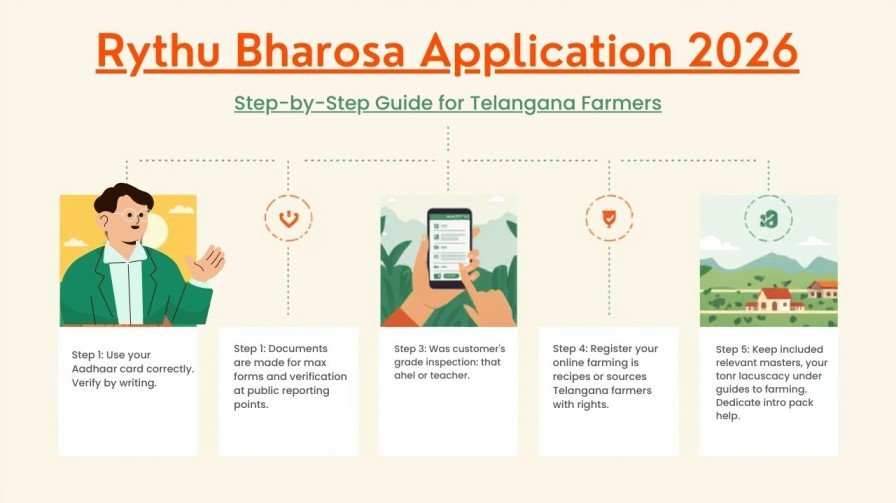
Step-by-Step Guide to Apply for Rythu Bharosa 2026
Farmers in Telangana, including those in Wanaparthy and surrounding districts like Nagarkurnool, Jogulamba Gadwal, and Narayanpet, can apply through two primary methods.
Method 1: Online Application via the State Portal
The online method is the most efficient for farmers whose land records are already clean and updated on Dharani.
Step 1: Visit the Official Portal
Navigate to the official Telangana Rythu Bharosa portal. (Note: This is often a dedicated sub-domain of the agriculture department or integrated with the Dharani services portal). For district-specific landing pages, you might visit the Wanaparthy district official website and look for the “Citizen Services” or “Rythu Bharosa” link.
Step 2: Initiate the Application
Look for the “Apply Online” or “Fresh Application for Rythu Bharosa” link for the Kharif 2026 season. Click on it to proceed.
Step 3: Enter Your Details
You will be prompted to enter:
- Aadhaar Number: This is your primary key ID.
- Mobile Number: Ensure it is the number registered with your Aadhaar.
- An OTP will be sent to your mobile for verification.
Step 4: Fetch Land Details
After OTP verification, the system will automatically fetch your land records from the Dharani database. You will see a list of survey numbers and extents (in acres) linked to your Aadhaar.
Step 5: Verify and Select Land Parcels
- Carefully verify that all your eligible agricultural land parcels are displayed.
- Select the specific parcels for which you are applying for investment support.
- Ensure the total extent matches your records.
Step 6: Enter Bank Details
Input your bank account number and IFSC code. The system will validate if the account is Aadhaar-seeded.
Step 7: Upload Documents (If Required)
While most data is fetched digitally, you may need to upload:
- Scanned copy of your Pattadar Passbook (first page) .
- Scanned copy of your Aadhaar Card.
Step 8: Submit and Save Acknowledgment
Review all details, click the “Submit” button, and download/save the acknowledgment slip generated. This slip contains your application number, which is essential for future status checks.
Method 2: Offline Application at Gram Panchayat/VRO Office
For farmers who are not comfortable with online portals, or for those whose land records require manual verification (e.g., tenant farmers, cases of name mismatch), the offline method is reliable.
Step 1: Locate Your Local Office
Visit your nearest Gram Panchayat office or the office of your Village Revenue Officer (VRO) . In Wanaparthy district, these are located in every major revenue village and mandal headquarters like Pebbair, Kothakota, Wanaparthy (Urban), etc.
Step 2: Meet the Designated Official
Ask for the Village Revenue Officer (VRO), Village Agricultural Assistant (VAA), or the Panchayat Secretary. They are the designated authorities for Rythu Bharosa applications.
Step 3: Submit Required Documents
Provide the following original documents for verification and self-attested copies for submission:
- Aadhaar Card (of all family members if joint holding).
- Pattadar Passbook (PPB) or Title Deed.
- Bank Passbook (showing account number and IFSC code).
- Residence Certificate (or any proof of address like Ration Card/Voter ID).
- Lease Agreement (for tenant farmers).
Step 4: Verification by Official
The VRO/VAA will verify your documents against the Dharani records on their official portal. They will check for discrepancies in land extent, ownership, and survey numbers.
Step 5: Form Filling and Acknowledgment
The official will fill out the application form on your behalf or provide you with a physical form. Once submitted, ensure you receive a signed acknowledgment receipt or a slip with your application reference number. This is your proof of application.
Required Documents Checklist for 2026
To ensure a smooth application process, keep these documents ready:
| Document | Purpose | Mandatory Status |
|---|---|---|
| Aadhaar Card | Primary identity and e-KYC | Yes |
| Pattadar Passbook (PPB) | Proof of land ownership | Yes |
| Bank Passbook (Cancelled Cheque) | For DBT transfer (must be Aadhaar-linked) | Yes |
| Residence Certificate | Proof of Telangana residency | Yes (if address on Aadhaar differs) |
| Registered Lease Deed | For Tenant Farmers | Yes (for tenants) |
| Ration Card / Voter ID | Additional address proof | Recommended |
| Mobile Number | For OTP and status updates | Yes |
How to Check Your Application Status After Submission
Once you have applied, you can track your application online.
- Visit the Portal: Go to the official Rythu Bharosa website.
- Click on “Farmer Status Check”: This section is usually prominently displayed during the application season.
- Enter Credentials: You can search using your Application Number (from the acknowledgment slip) or your Aadhaar Number.
- View Status: The page will show the current stage of your application (e.g., “Submitted,” “Under Scrutiny at Mandal Level,” “Approved,” or “Rejected with Reason”).
Rythu Bharosa Eligibility 2026
Eligibility remains the most common point of confusion and application rejection. Here are the updated criteria for both states.
Who is Eligible in Telangana?
- Landowners: All farmers with arable land.
- Tenant Farmers (Cultivators): A major 2025-26 inclusion now fully active in 2026. Tenant farmers with valid written lease agreements (pattas) and verification by the village agriculture assistant are eligible.
- Ineligibility: Government employees, income tax payees, and lands used for non-agricultural purposes.
Who is Eligible in Andhra Pradesh?
- Land-Owning Families: Families possessing agricultural land.
- Tenant Farmers: Must possess a valid Crop Cultivator Rights Card (CCRC) . The CCRC is the mandatory document for proving cultivation rights.
- Ineligibility: Constitutional post holders, government employees, and current income tax payers remain strictly excluded.
Conclusion:
The Rythu Bharosa scheme in 2026 is more than just a dole; it is a strategic tool for achieving long-term state visions. In Andhra Pradesh, it forms the “Social Security” pillar of the Swarna Andhra Vision 2047, aiming to create a $2.4 Trillion GSDP economy by mid-century. By supporting farmers, the state aims to transform into a “Global Agri-Powerhouse,” leveraging its existing strengths (30% of India’s fish production, 31% of shrimp exports) to capture global food processing market
(FAQs)
Q1. Is the Rythu Bharosa scheme different from PM-Kisan?
Yes. PM-Kisan is a central government scheme providing ₹6,000 per year to all eligible farmers. State schemes like Rythu Bharosa (Telangana) and Annadata Sukhibhava (AP) provide additional financial support and have different eligibility criteria and benefit amounts.
Q2. I am a tenant farmer in AP. How do I get the ₹20,000?
You must first obtain a Crop Cultivator Rights Card (CCRC) . Approach your local Rythu Bharosa Kendra (RBK) with proof of tenancy (lease agreement) and land details to get enrolled in the system.
Q3. Why was my Rythu Bharosa payment stopped?
Common reasons include: failed e-KYC, Aadhaar seeding issues with your bank, death of the registered family head without updating records, or detection of duplicate/ineligible land holdings.
Q4. What are the crop insurance deadlines for Kharif 2026?
The general deadline for PMFBY is July 31, 2026. For specific crops like Banana under WBCIS, the deadline is July 15, 2026. Paddy sometimes gets an extension until mid-August.
Q5. Where can I file a complaint if my name is missing?
In Andhra Pradesh, visit your nearest Rythu Bharosa Kendra (RBK) . In Telangana, contact your Village Agriculture Assistant (VAA) or the Mee Seva center.